Tickets for the 2024 Verona Opera Festival are now available, with a wide range of performances premiering with Turandot on the 8th June and ending with Carmen on the 7th September.
Celebrating Italian Opera - The Cultural Heritage of Humanity - Friday 7th June 2024:
The season will kick off with an extraordinary celebration of of Italian Opera, featuring hundreds of singers and musicians, a star-studded performance to launch the 101st Arena Opera Festival!
A limited number of tickets are available, so please email us at info@tickitaly.com if you'd like more information.
Nabucco is not being performed at the 2024 Verona Opera Festival. Click here for the full list of performances.
Giuseppe Verdi is today one of the heavyweights of the opera canon, his works ever-present in the standard repertoire of opera houses worldwide well over a century after their composition. The northern Italian composer lived into his late eighties and was extraordinarily prolific - producing 28 operas from Oberto, Conte di San Bonifacio (1839) until his swansong, Falstaff in 1893. Along the way he wrote some of the heavyweights that are performed to this day, including Il Trovatore, Rigoletto and Aida. But it was with Nabucco, his third opera and written in 1842, that this giant of Italian Romantic music genuinely arrived.
With its Italian libretto by Temistocle Solera, itself taken from a play by Anicet Bourgeois and Francis Cornu, Nabucco addresses the biblical story of Nebuchadnezzar ('Nabucodonosor' in Italian, which becomes contracted to 'Nabucco'). The opera made its debut at Milan's Scala opera house on 9 March 1842. It set the tone of Verdi's works by being a popular as much as a critical hit - indeed the sniffier critics would accuse Verdi of catering to the common taste. Certainly a Verdi opera is guaranteed to be of melodramatic flavour and packed with good, hummable tunes, but that is no problem for most of us.
A performance of Nabucco typically lasts for 135 minutes (plus intermission). A four-act opera, the piece is scored for two clarinets, two bassoons, four French horns, two trumpets, two flutes (one of these doubles as piccolo), two oboes (one doubles as English horn), two tenor trombones and one bass trombone, a cimbasso, timpani, bass drum, cymbals, side drum, triangle, two harps, strings, and an onstage band. Our characters are King Nabucco (baritone); Abigaille, supposedly his elder daughter, of which more below (soprano); Fenena, his daughter (mezzo-soprano); Ismaele, son of the King of Jerusalem (tenor); Zaccaria, high priest of the Jews (bass); Anna, Zaccaria's sister (soprano); Abdallo, Babylonian soldier (tenor); the high priest of Baal (basso); and assorted soldiers and people. The setting takes in the Hanging Gardens of Babylon, the Banks of the River Euphrates and the Palace of Babylon.
> Seating > Tips & practicalities > About the Operas > Transport & arrival > Introduction
The story follows the persecution of the Jews by Babylonian ruler Nabucco. The king has invaded Jerusalem and is busy looting the city. His daughter (or not as it transpires) is one Abigaille, who falls in love with Ismaele, the nephew of the King of Jerusalem. She tells him that the city can be saved if he returns her love. Ismaele refuses and Nabucco continues his plunder, looting and burning the temple. Abigaille discovers that she is not in fact Nabucco's daughter, but the embittered princess conceals the fact and eggs her father on to kill all the Jews. She meanwhile is plotting to steal Nabucco's throne. Nabucco remembers that his other daughter, Fenena, a convert to Judaism, is among the condemned, and seeks out the document that proves Abigaille has no true claim to the throne. Finding it, he leads his men to halt the execution. Well nobody ever said the narrative of operas had to be entirely convincing - Nabucco is though high on drama and has one of Verdi's most memorable choruses in 'Va, pensiero sull'ali dorate' (Fly, thought, on golden wings), which is often demanded as an encore (conductor permitting).
Please note that an Agency handling fee per item will be added during checkout.
Seating key Tickets marked as Poltrone (reduced) are only available for visitors under 30 years old or over 65 years old. Please note that you may be asked for a document proving your age in order to enter. Click here for more information on ticket types for the Verona Arena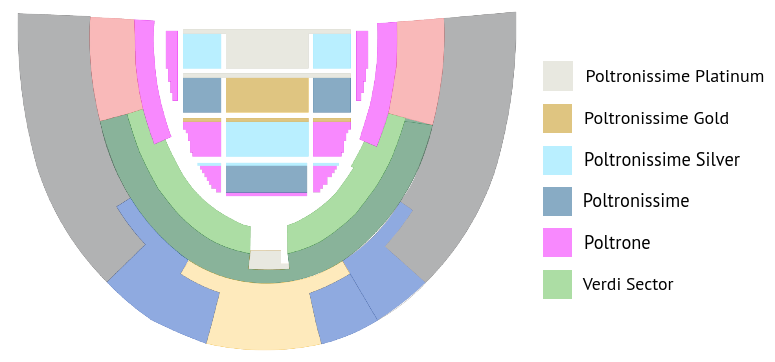
 Click here for information on ticket types, plus a seating plan for the Verona Arena
4.1 stars out of 5 from 8 ratings.